


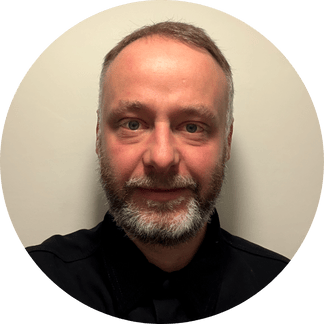
John Bellerby is one of the improvement specialists supporting members of the Evolve Collaborative to use the data at their fingertips and our peer learning communities to drive service improvements and savings at their trusts.
He knows what it takes to be at the forefront of leading improvement in the NHS.
When Salford Royal NHS Foundation Trust set up its quality improvement team in 2007, I was the first recruit. Having then-Secretary of State for Health Alan Johnson launch it to much fanfare and attend the first-ever quality improvement event I (or the organisation) had ever led was certainly a baptism of fire.
But over the following just over a decade and a half, I’ve learnt what it takes to drive improvement in the NHS.
Starting in Salford as a project manager, I had little understanding of what I was going into and zero previous experience in healthcare. I moved through the quality improvement team at Salford and became more interested in the theory of quality improvement, sometimes called the science of quality improvement. As the first – and for a good while, only - member of the team I just had to get involved in everything.
I quickly became passionate about working with clinical teams to help them improve their services for their patients. I learned that most clinicians were passionate about improving their services and often knew in detail what the problems were, but they often lacked the skills (and crucially time) to do a great deal about it.
My role was to do provide structure and the leg work that meant the clinicians could develop their ideas to improve. It was about supporting them to run Plan, Do, Study, Act cycles so that we could learn from them.
I received formal training on the improvement advisor course at the Institute for Healthcare Improvement (the IHI) which was career changing for me. It exposed me to the individuals who, internationally, had brought healthcare improvement into the mainstream.
I was taught there by individuals who had worked directly with W. Edwards Deming who is an instrumental figure in the world of improvement and known for helping transform manufacturing in Japan and helping develop and cement Japan’s status for efficient, effective manufacturing.
Spending time at the IHI helped me realise that quality improvement is more than a collection of tools, techniques, methodologies and project wrappers.
It is a way of thinking about how systems work, interact, perform and are influenced by the environment and the people who work in them. It is key that you understand this when you are trying to improve something and before you even start to think about what tools and techniques you are going to employ to intervene in the problem.
Salford Royal was one of the first organisations awarded an ‘outstanding’ rating by the CQC. The quality improvement approach of the organisation was recognised as being a key part of the success - we received so many enquiries from people and organisations wanting to see what we were doing that we ran quarterly open days on our approach.
At Bradford NHS Foundation Trust, I led the quality improvement team in a role which was much more focussed on how to lead improvement in an acute organisation and how to operate at a senior level to ensure that the organisation responds to issues and problems in a way that is most likely to help them to be resolved effectively. I was proud to lead the team that established a mortality oversight structure at the trust.
Returning to Salford, I ultimately become director of quality improvement at Northern Care Alliance.
Following my time at Bradford I returned to Salford but this time the organisation was establishing itself as a group hospital with Pennine Acute NHS Foundation Trust and would become known as the Northern Care Alliance.
This time the team was four times bigger and our focus was on how we would establish a quality improvement approach across the five hospitals (Salford Royal, North Manchester, Fairfield, Royal Oldham and Rochdale) while helping to realise the benefits of moving to a group model, with . 20,000 staff,
Through my time in improvement I have had the opportunity to receive formal training in clinical microsystems, lean approaches, experience-based design among many others. I have an MSc in healthcare leadership and a level seven apprenticeship in leadership.
It’s exciting for me now to be bringing these skills and experiences to the Evolve Collaborative, supporting our members to drive change in their own trusts.
Evolve is exactly the kind of thing I wish I had access to throughout my career working in improvement at trusts. Being able to interrogate the data, benchmark with peers and use predictive insights, but then crucially to collaborate with others to find solutions to knotty issues. I saw quality improvement evolve from my time working in trusts from being a one-person QI team to being a valued and thriving directorate. The Evolve Collaborative offers a chance to take that further – a proven model for improvement that allows us to drive change together, powered by data.
Key achievements
Some of the projects that I have led or led the team include:
Reducing cardiac arrests
Reducing acute kidney injury
Reducing Clostridium difficile infection
Reducing hospital acquired pressure ulcers
Reducing catheter related urinary tract infections
Improving the response to sepsis
Eliminating the most serious grades of pressure ulcers for several years
Improving end of life care through the delivery of the Swan Model (which is now adopted by many organisations across the NHS further afield)
Improving patient satisfaction
Improving vitamin D optimisation in surgical patients
Reducing the number of days kept away from home frail older patients spend
Establish a quality improvement reporting process for Boards and Committees using quality improvement measurement theory (statistical process control charts, funnel plots, pareto charts, etc)
Establishing of organisation wide quality improvement teaching programmes